
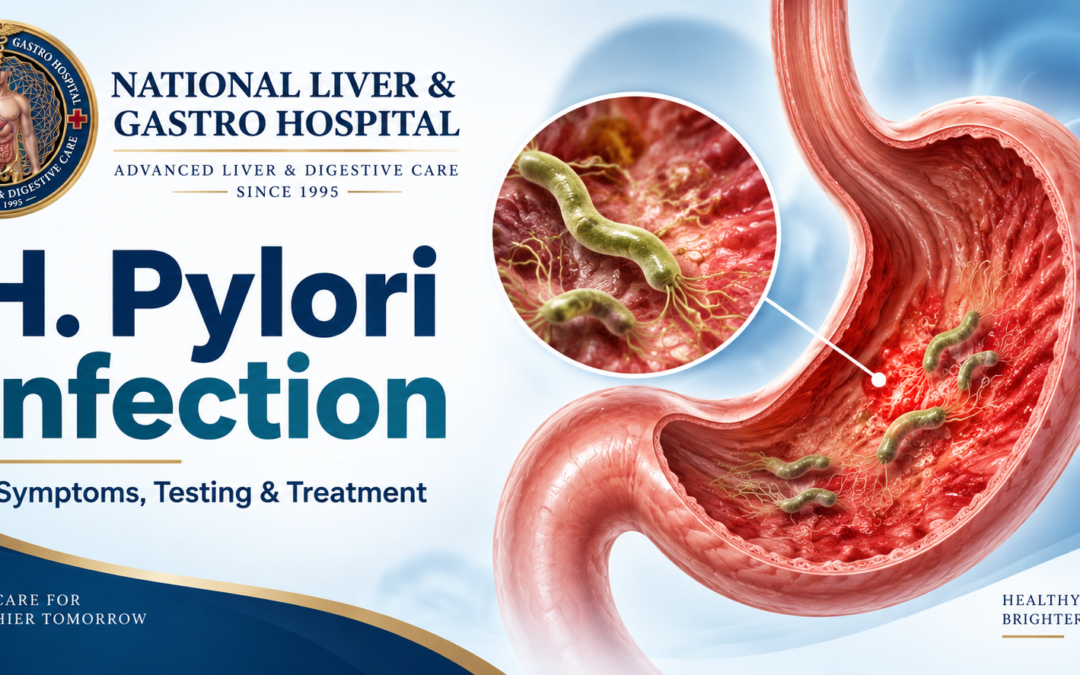
H. Pylori Infection: Symptoms, Testing, Treatment and When to See a Gastroenterologist in Guntur
“`htmlYou have been taking medicines for acidity for weeks, but the burning sensation keeps coming back. Some days you feel pain or discomfort in the upper stomach, while on other days you feel bloated, full quickly or slightly nauseous after meals.
Sometimes these symptoms are blamed on spicy food, irregular meals or stress. While these can affect digestion, another possible cause is an infection called Helicobacter pylori, commonly known as H. pylori.
H. pylori is a bacterium that can live in the stomach lining. Many people with the infection have no obvious symptoms, but in some people it can contribute to gastritis, peptic ulcers and other stomach problems. This is why identifying the infection and treating it appropriately can be important.
If you are looking for H pylori treatment in Guntur, the first step should not be choosing a medicine yourself. A gastroenterologist can assess your symptoms, decide whether testing is appropriate and select treatment based on your medical history and previous antibiotic exposure.
Persistent Stomach Problems Need the Right Diagnosis
If acidity, upper stomach discomfort or ulcer symptoms keep returning, a proper gastroenterology evaluation can help identify the underlying cause.
Call +91 94402 14706 WhatsApp Us Book an AppointmentWhat Is H. Pylori Infection?
Quick answer: H. pylori is a type of bacterium that can infect the stomach lining. Some people have no symptoms, while others may develop upper abdominal discomfort, burning, nausea, bloating or ulcer disease. Testing can help determine whether the infection is present when your symptoms or medical history make testing appropriate.
The stomach has natural protective mechanisms that help it tolerate acid. H. pylori can interfere with some of these protective processes and contribute to inflammation of the stomach lining.
Not everyone with H. pylori develops an ulcer or significant symptoms. However, the infection is associated with peptic ulcer disease and is also considered an important risk factor for certain stomach cancers. For this reason, a confirmed infection should be discussed with a qualified gastroenterologist rather than ignored.
What Are the Symptoms of H. Pylori Infection?
One of the challenges with H. pylori is that symptoms can be different from one person to another. Some people remain completely symptom free.
When symptoms occur, they may include:
- Burning or discomfort in the upper abdomen
- Repeated acidity or indigestion
- Bloating after meals
- Frequent belching
- Nausea
- Feeling full sooner than usual
- Reduced appetite
- Upper abdominal pain that comes and goes
- Symptoms that are worse when the stomach is empty in some people
These symptoms do not automatically mean that you have H. pylori. Gastritis, acid reflux, functional dyspepsia, gallbladder disease, medication related irritation and several other conditions can cause similar complaints.
That is why testing and clinical evaluation are more useful than assuming that every case of acidity is an H. pylori infection.
Can H. Pylori Cause Stomach Ulcers?
Yes. H. pylori is one of the important causes associated with peptic ulcer disease. An ulcer is an open sore that develops in the lining of the stomach or the first part of the small intestine.
People with an ulcer may experience burning or pain in the upper abdomen, nausea, early fullness or discomfort between meals. However, some ulcers cause few symptoms until complications occur.
Important: Black stools, vomiting blood, severe persistent abdominal pain, fainting or significant weakness can indicate gastrointestinal bleeding or another serious condition. These symptoms require prompt medical evaluation rather than self-treatment for acidity.
How Is H. Pylori Diagnosed?
There are several ways to test for H. pylori. The appropriate test depends on your symptoms, medical history and whether you have already received treatment.
1. Urea Breath Test
A urea breath test is a non-invasive method used to detect active H. pylori infection. It can also be useful after treatment to check whether the infection has been successfully eliminated.
2. Stool Antigen Test
A stool antigen test looks for evidence of H. pylori in a stool sample. Like the breath test, it can help identify an active infection and can be used for follow-up testing after treatment.
3. Upper GI Endoscopy With Biopsy
If you have alarm symptoms, persistent symptoms or other reasons that make endoscopy appropriate, a gastroenterologist may recommend an upper GI endoscopy. During the procedure, the doctor can examine the food pipe, stomach and upper small intestine and may take a small biopsy from the stomach lining.
Endoscopy is particularly useful when the doctor needs to look directly for ulcers, inflammation, bleeding or other abnormalities rather than simply checking for H. pylori.
4. Blood Testing
Blood tests can detect antibodies against H. pylori, but they may not reliably distinguish a current infection from a previous infection. For this reason, other testing methods may be preferred when the goal is to identify an active infection or confirm eradication.
| Test | What It Can Help Determine | Typical Use |
|---|---|---|
| Urea breath test | Evidence of active H. pylori infection | Initial testing and follow-up in appropriate patients |
| Stool antigen test | Evidence of active infection | Initial testing and confirmation after treatment |
| Endoscopy with biopsy | H. pylori plus direct examination of the stomach | Selected patients with persistent or concerning symptoms |
| Blood antibody test | Evidence of exposure to H. pylori | Less useful when confirming active infection |
When Should You Get Tested for H. Pylori?
Not every person with occasional acidity needs an H. pylori test. A gastroenterologist can consider your symptoms and medical history before recommending testing.
Testing may be considered in situations such as:
- Persistent upper abdominal discomfort or indigestion
- Peptic ulcer disease
- A previous history of H. pylori infection
- Repeated stomach symptoms that do not improve as expected
- Some patients with dyspepsia after appropriate medical assessment
- Selected patients with a relevant family or medical history
If you have warning signs such as unexplained weight loss, repeated vomiting, anemia, gastrointestinal bleeding, difficulty swallowing or a strong family history of stomach cancer, your doctor may recommend a more detailed evaluation rather than relying only on a simple H. pylori test.
How Is H. Pylori Treated?
H. pylori treatment usually involves a combination of medicines rather than a single antibiotic. Treatment commonly includes acid suppression along with antibiotics and, depending on the selected regimen, other medicines such as bismuth.
The exact combination should be chosen by a doctor. Previous antibiotic exposure, medication allergies, previous H. pylori treatment and local antibiotic resistance patterns can affect treatment decisions.
Modern clinical guidance has moved away from automatically using the same antibiotic combination for every patient. In particular, some antibiotic resistance patterns can reduce the effectiveness of certain older regimens. This is one reason why self-medicating with leftover antibiotics is not a good approach.
Why Completing the Full Treatment Matters
H. pylori treatment can involve several medicines taken for a defined period. Missing doses or stopping treatment early can reduce the chance of successful eradication and can make future treatment more difficult.
Some people experience temporary side effects such as nausea, changes in taste, loose stools or stomach discomfort while taking treatment. If side effects become difficult to manage, contact your doctor rather than stopping the medicines without advice.
Do not start H. pylori antibiotics without medical advice. The correct treatment depends on your individual medical history, previous antibiotic exposure and the treatment approach selected by your gastroenterologist.
How Do You Know If H. Pylori Treatment Worked?
Feeling better does not always prove that H. pylori has been eliminated.
For appropriate patients, a follow-up test is used after treatment to confirm eradication. Current clinical guidance recommends confirming that the infection has been successfully cleared rather than assuming that symptom improvement means the treatment worked.
The follow-up test may involve a urea breath test or stool antigen test, depending on the circumstances. The timing of the test and temporary changes to medicines such as acid suppressants are important because testing too soon or while taking certain medicines can affect the accuracy of the result.
Your gastroenterologist will tell you when to perform the test and which medicines may need to be paused beforehand.
H. Pylori and Gastritis: Are They the Same?
No. Gastritis means inflammation of the stomach lining, while H. pylori is one possible cause of that inflammation.
Other factors can also contribute to gastritis, including certain medicines, alcohol, autoimmune conditions and other forms of stomach irritation.
This distinction matters because treating acidity alone may not address the underlying cause if H. pylori infection is present. A proper evaluation helps determine what is actually causing your symptoms.
Can H. Pylori Come Back After Treatment?
After successful eradication, the infection can be treated effectively, but a person can potentially become infected again. In adults, confirming eradication after treatment is therefore important.
If symptoms return after successful treatment, do not automatically assume that H. pylori has returned. Acid reflux, functional dyspepsia, gastritis, ulcers, dietary factors and other digestive conditions can produce similar symptoms.
A doctor can decide whether repeat testing or another evaluation is necessary.
What Should You Do While Being Treated?
There is no special food that can replace medical treatment for H. pylori. However, some practical habits can make digestive symptoms easier to manage.
- Take prescribed medicines exactly as directed.
- Avoid unnecessary painkillers that can irritate the stomach unless prescribed by your doctor.
- Limit foods that clearly trigger your symptoms.
- Reduce alcohol consumption and discuss alcohol use with your doctor.
- Avoid smoking and tobacco products.
- Do not share or reuse leftover antibiotics.
- Complete the prescribed treatment even if symptoms improve early.
- Attend the recommended follow-up test after treatment.
When Should You See a Gastroenterologist in Guntur?
If your stomach symptoms keep returning despite taking routine acidity medicines, it is worth finding out whether there is an underlying cause.
You should consider a gastroenterology consultation if you have:
- Persistent upper abdominal pain or burning
- Repeated indigestion or acidity
- A history of stomach or duodenal ulcers
- Frequent nausea or unexplained bloating
- Symptoms that repeatedly return after stopping acidity medicines
- Unexplained weight loss
- Repeated vomiting
- Difficulty swallowing
- Black stools or blood in vomit
- Known or suspected H. pylori infection
For patients looking for an H pylori doctor in Guntur, a specialist evaluation can help determine whether you need H. pylori testing, endoscopy or another form of digestive investigation.
Looking for H. Pylori Evaluation in Guntur?
Get your recurring stomach symptoms assessed by a gastroenterology team and discuss the right testing and treatment approach for your condition.
Call +91 94402 14706 WhatsApp Us View Location on Google MapsH. Pylori Care at National Liver & Gastro Hospital
At National Liver & Gastro Multispeciality Hospital in Guntur, stomach and digestive complaints are evaluated based on the patient’s symptoms, medical history and appropriate diagnostic findings.
The hospital provides gastroenterology care including evaluation of stomach and duodenal ulcers, H. pylori testing and eradication treatment, endoscopy and management of other digestive conditions.
If you have been taking acidity medicines repeatedly without understanding why your symptoms keep returning, a consultation can help determine whether further testing is appropriate.
You can visit the hospital in Guntur or check the exact location, directions and available information through the hospital’s Google Business Profile.
Frequently Asked Questions About H. Pylori
What is H. pylori?
H. pylori is a bacterium that can infect the stomach lining. Some people have no symptoms, while others may develop gastritis, indigestion, upper abdominal discomfort or peptic ulcers.
What are the common symptoms of H. pylori?
Possible symptoms include upper abdominal discomfort, burning, indigestion, bloating, nausea, frequent belching and feeling full quickly. However, many people with H. pylori have no symptoms.
What is the best test for H. pylori?
Urea breath testing and stool antigen testing are commonly used to detect active infection. In selected patients, an upper GI endoscopy with biopsy may also be recommended.
Can H. pylori be completely treated?
H. pylori can often be successfully eradicated with an appropriate combination of medicines. Completing treatment and confirming eradication afterward are important parts of care.
Can I treat H. pylori with acidity medicine alone?
Acid reducing medicines may help control symptoms, but they do not by themselves eradicate H. pylori. If an active infection is confirmed, specific eradication treatment prescribed by a doctor is required.
Can H. pylori cause ulcers?
Yes. H. pylori is an important cause associated with peptic ulcer disease. Patients diagnosed with an ulcer may therefore be evaluated for H. pylori infection.
Do I need a gastroenterologist for H. pylori treatment in Guntur?
A gastroenterologist can assess your symptoms, determine whether H. pylori testing is appropriate and select a suitable treatment plan based on your medical history and previous treatment.
How do I know whether H. pylori treatment has worked?
Symptoms improving is not enough to confirm eradication. A follow-up breath test, stool antigen test or another appropriate test may be recommended after treatment to confirm that the infection has been cleared.
Where can I get H. pylori treatment in Guntur?
National Liver & Gastro Multispeciality Hospital provides gastroenterology evaluation and care in Guntur. You can contact the hospital at +91 94402 14706 or check the hospital location on Google Maps before visiting.
Take Persistent Stomach Symptoms Seriously
Occasional acidity after a heavy meal is common. But when upper abdominal discomfort, indigestion, bloating or ulcer symptoms keep returning, repeatedly taking acidity medicine without finding the underlying cause may not be enough.
H. pylori is one possible cause, and appropriate testing can help determine whether it is present. If the infection is confirmed, completing the prescribed treatment and confirming eradication can help reduce the risk of ongoing infection and related complications.
If you are searching for H pylori treatment in Guntur, speak with a qualified gastroenterologist about your symptoms and medical history before starting treatment.
View National Liver & Gastro Hospital on Google Maps
National Liver & Gastro Multispeciality Hospital
+91 94402 14706 | nationallivergastro.com
Guntur, Andhra Pradesh. View on Google Maps
Monday to Saturday, 9 AM to 8 PM
Disclaimer: This article is intended for general health awareness only and does not replace professional medical advice, diagnosis or treatment. H. pylori testing and treatment should be determined by a qualified healthcare professional based on the patient’s individual condition. Treatment outcomes vary from patient to patient.